It had to be eaten hot.
Not lukewarm, not wrapped an hour earlier and not reheated. Hot enough to require a little patience, with sugar sticking to your fingers and a thick, airy dough pulled apart piece by piece.
For generations of people in Toulon, chichi frégi had little to do with sophisticated gastronomy. It belonged to something far harder to replace: habit.
You went to the market. You walked along Cours Lafayette. You saw the kiosk. You bought a chichi.
That was all.
And that may be precisely why its disappearance now feels so peculiar. The symbols of a city are not always the monuments people photograph. They can also be ordinary things everyone assumes will always be there.
Toulon’s chichi frégi was one of them.
1907 and the beginning of the Toulon story
One qualification is necessary from the outset. Saying that chichi frégi was simply “invented” in Toulon in 1907 reduces a more complicated history to a convenient date.
Versions of the Provençal fried pastry already existed in southern France, with recipes and names varying between places. Marseille has its own powerful claim to the tradition through L’Estaque, where chichi became an institution from the 1930s. Marseille’s tourist office still describes a thick, airy dough using ingredients including wheat flour, chickpea flour and orange blossom water — distinctly different from the thin, twisted churro with which it is so often confused.
For Toulon, however, 1907 remains the essential date.
That was when Alexis Guglielmi, from a family that had arrived from Italy, established the family chichi business in the city. The tradition settled around Cours Lafayette and gradually became inseparable from Toulon’s market. Four generations of the Guglielmi family would go on to make the fritters.
A sweet snack became a landmark.
People no longer needed to ask where to buy “a fritter”.
They went for “the chichi”.
And they knew exactly which one they meant.
The Cours Lafayette kiosk
The setting mattered.
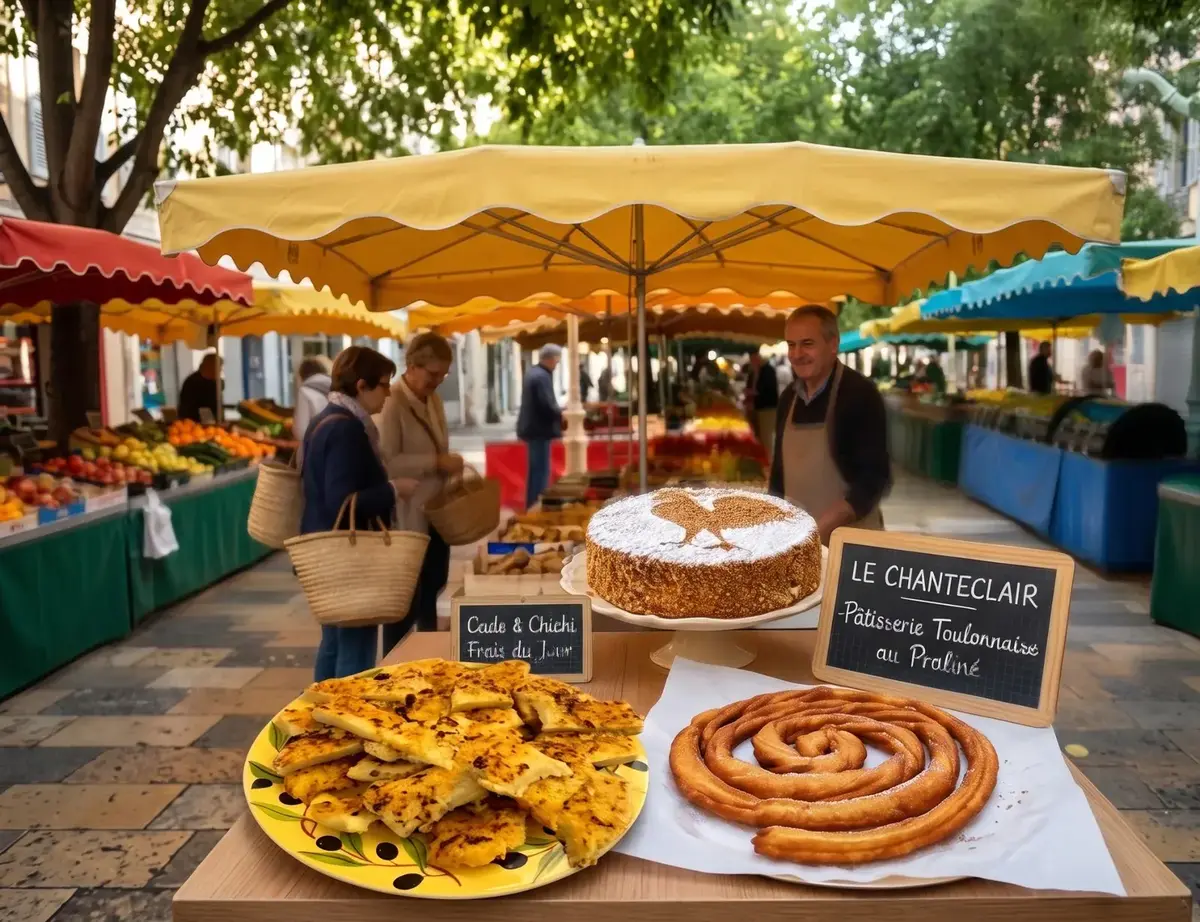
Cours Lafayette is no ordinary Toulon street. Its market has existed since the eighteenth century and remains one of the city’s most recognisable scenes, filled with fruit, vegetables, flowers, spices and Provençal produce. Toulon’s municipal history records the first market stalls there as early as 1750.
This became the natural stage for chichi frégi.
For decades, the Guglielmi family operated a kiosk there, notably on Place Paul-Comte. In 2022, fourth-generation maker Marc Guglielmi recalled that the stand had remained there for more than fifty years.
To understand the attachment, it is necessary to imagine more than a shop.
The smell of frying dough.
A queue.
The noise of the market.
Shopping bags put down for a moment while somebody ate.
Parents telling children to wait until it cooled, and children predictably refusing to wait.
Sugar falling onto the pavement.
Popular food is often tied as strongly to a place as it is to a recipe. Moving the product does not necessarily move the memory with it.
The kiosk and Cours Lafayette belonged together.
A recipe kept within the family
Part of the story remains secret.
Within the Guglielmi family, the recipe was handed down rather than published. Marc Guglielmi said he received it from his father Claude and became its custodian. Its exact composition has therefore never been made public.
That secrecy helped create the legend.
It also explains why any discussion of the “real” Toulon chichi requires care. Chichi frégi recipes continue elsewhere in Provence, particularly at L’Estaque. They may be excellent. They are not necessarily the G.Toine recipe.
The pastry itself is already clearly distinguishable from a churro.
It is generally wider, thicker and less regular, with a raised dough producing a much airier interior. Provençal versions may include chickpea flour and orange blossom. At L’Estaque, the dough is laid into the oil in a long coil before being cut with scissors after frying.
The result bears little resemblance to the standard fairground churro.
In Toulon, that distinction became almost a matter of local identity.
The disappearance begins
The first visible turning point came in 2007.
The family left the historic kiosk and moved to 8 rue Vincent-Courdouan, still in the old centre and close to Cours Lafayette. G.Toine continued to draw regular customers, but something had already changed: chichi was no longer sitting in the middle of the market as part of its scenery.
The kiosk itself disappeared in 2010.
Another trader had occupied it after the Guglielmis left, but with no successor the structure was eventually removed. Fourteen years later, when a Toulon resident attempted to revive a chichi kiosk on Cours Lafayette, the municipality said that restoring one was not planned.
At first, however, losing the kiosk did not mean losing the chichi.
The familiar taste was still only a short walk away in rue Courdouan.
For another twelve years, the thread held.
Then came 2022.
115 years, then departure
In the summer of 2022, a “For Sale” sign appeared outside G.Toine.
Marc Guglielmi announced that he and his family were leaving Toulon, the Var and the region. He made clear that the premises were being sold, but not the family tradition itself. The recipe would remain with the Guglielmis.
The historic shop closed that autumn.
The figures show the scale of what ended: from 1907 to 2022, 115 years had passed since the start of the family’s Toulon business.
Four generations.
A kiosk that had become a memory.
Then a shop.
Then a closed shutter.
Marc Guglielmi subsequently moved to the Lot. Speaking in 2024 about another proposed Toulon revival, he was explicit that the original recipe remained the property of his family and had left the Var with him. He said his son might one day inherit it and that, if the historic version were reborn, it would not necessarily happen in Toulon.
That was arguably the real break.
A shop can close and be replaced.
A speciality can move address.
But when the recipe, the know-how and the family that carried both leave together, continuity is broken.
The 2023 comeback — but not the same chichi
For almost a year, Toulon was left without its historic chichi business.
Then, at the end of summer 2023, it returned to rue Vincent-Courdouan.
Patrick Mary opened Le Chichi fregi toulonnais a few metres from the former G.Toine shop. The intention was openly nostalgic: to preserve a piece of local food culture for younger generations.
But he did not claim to possess the Guglielmi recipe.
Instead, he explained that his formula came from L’Estaque and acknowledged that it was therefore different from Toulon’s historic version.
The distinction matters.
In 2023, chichi returned geographically to Toulon.
The Guglielmi chichi did not.
The venture could reasonably be viewed as a tribute, an adaptation or the beginning of another tradition. At the very least, it showed that demand and memory had not disappeared.
The business itself did not last.
Administrative records available in August 2026 show that Le Chichi Fregi Toulonnais ceased trading and was formally removed from the register on 10 March 2025. Its rue Vincent-Courdouan establishment had already closed in November 2024.
The comeback proved brief.
The kiosk some wanted to bring back
Meanwhile, another project returned the story to Cours Lafayette.
In January 2024, Var-Matin reported on a proposal by Toulon resident Jamila Laronze. Her aim was not simply to sell chichis but to restore what the city had visibly lost: a dedicated kiosk on Cours Lafayette.
She said she had reconstructed a recipe from taste memories and tested it during Toulon’s Christmas market. The intention was clearly linked to local heritage, combining the food with its former setting and public ritual.
The municipal response reported at the time was straightforward: there were no plans to reinstate a chichi kiosk.
The project also drew a response from Marc Guglielmi, who disputed suggestions that his original family recipe had been discussed or shared. The episode showed how sensitive the apparently simple matter of a fried pastry had become: it involved a family inheritance, collective memory and the difficult question of who can legitimately claim a tradition.
Marseille kept it; Toulon lost it
The comparison with L’Estaque is uncomfortable.
In Marseille, three traditional chichi stands still make the pastry a destination in itself. Marseille’s tourist office continues to present it as part of the neighbourhood ritual: people travel to L’Estaque, queue and leave with a hot chichi.
Toulon followed the opposite path.
The kiosk disappeared in 2010.
The historic family left in 2022.
The 2023 revival failed to survive.
A proposal to restore a kiosk did not secure a return to Cours Lafayette.
And in 2026, the company behind the most recent specialist business is officially closed.
That does not mean a pastry called “chichi” can never appear at a fair, market or temporary stall in Toulon.
But that is not quite the same thing.
What disappeared was continuity.
A piece of heritage nobody thought to protect
The chichi frégi story raises a broader question: what does a city consider to be heritage?
Old buildings are protected.
Paintings enter museums.
Archives are preserved.
Fountains are restored.
A popular recipe held by one family for four generations is much more fragile.
It can disappear within months.
All it takes is a departure, the end of a transmission or a shop closing.
Nobody necessarily did anything wrong. A family is entitled to leave. An artisan cannot be expected to work indefinitely simply to maintain a city’s memories. Nor can a municipality require somebody to reveal a secret recipe.
The result remains striking.
Toulon still has Cours Lafayette.
It still celebrates its Provençal market.
Cade remains part of local food culture.
Yet one of the products that allowed generations to experience that market through taste and smell has disappeared from ordinary life.
There is no longer an obvious permanent address to give a visitor and say: “Go there and taste Toulon’s chichi.”
A symbol because it was ordinary
That may be the best definition of a genuine popular symbol.
Nobody needed a plaque explaining chichi frégi.
People in Toulon knew.
Those returning after years away looked for it.
Those who had left the city talked about it.
Parents took their children because their own parents had once taken them.
It was neither sophisticated nor particularly photogenic. It cost only a few euros. People ate it standing up.
But for four generations, the same ritual repeated itself.
Buy.
Wait a few seconds.
Burn your fingers slightly.
Blow on it.
Eat.
That repetition is how traditions are made.
Chichi frégi continues to live elsewhere in Provence, most visibly at L’Estaque. The Guglielmi recipe has not vanished either: Marc Guglielmi was still saying in 2024 that it would remain within his family.
What is missing is something else.
Toulon’s chichi frégi still has a history.
It still has memories.
Somewhere, it even still has its recipe.
It simply no longer has Toulon.
Toulon and the chichi frégi will have never the same tast!