
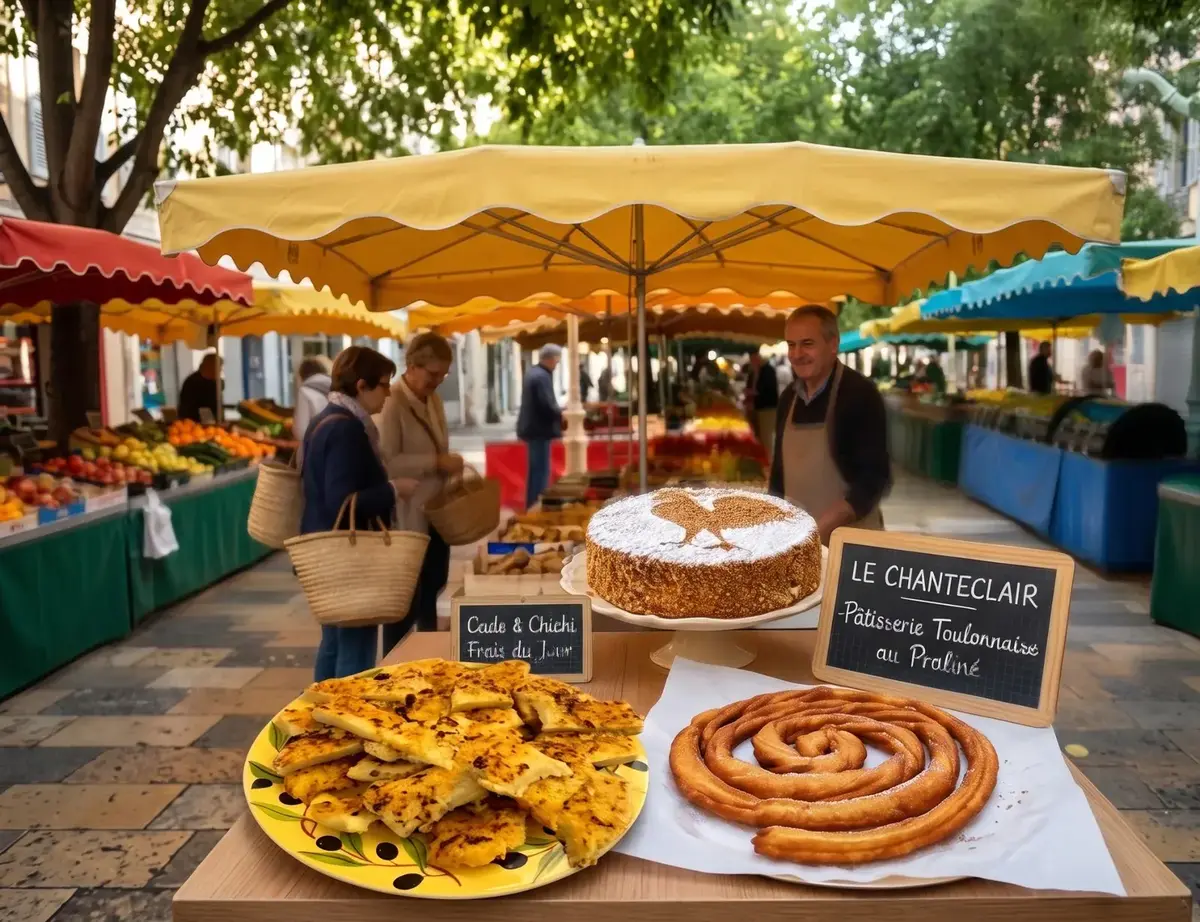
It lacks the immediate simplicity of cade.
It is not something traditionally eaten standing in the market like chichi frégi.
And explaining it to somebody who has never encountered Chanteclair usually produces a rather odd sentence:
“It’s a frozen meringue cake with coffee-praline cream, hazelnuts… and a rooster on top.”
A rooster?
Yes.
Because Toulon also managed to turn a play by Edmond Rostand into dessert.
Almost a century later, it still works.
Chanteclair is one of those specialities many people from Toulon have known since childhood, yet it becomes surprisingly difficult to encounter once you leave the Var. It never achieved the national fame of Aix calissons, Bordeaux canelés or Saint-Tropez’s tarte tropézienne.
It did something else.
It stayed home.
A pastry chef named Calvi
The story begins during the 1930s with a Toulon pastry chef known as Monsieur Calvi.
The sources agree on one point: he is credited with creating Chanteclair.
The exact year is less certain, and it is better to acknowledge that than manufacture a convenient date. Several accounts place its creation around 1930. The current Le Chanteclair pastry shop, which presents itself as preserving the creator’s recipe, gives 1935. Var-Matin uses the safer description of a dessert “born in the 1930s”.
The reliable version is therefore straightforward: Chanteclair was created in Toulon by M. Calvi during the 1930s.
Its name has nothing to do with a particularly musical pastry chef working before sunrise.
It comes from Edmond Rostand.
The rooster who thought he raised the sun
In 1910, the author of Cyrano de Bergerac premiered a highly unusual play at Paris’s Théâtre de la Porte-Saint-Martin: Chantecler.
Not Chanteclair.
Chantecler.
The Bibliothèque nationale de France records the premiere on 7 February 1910, with Lucien Guitry playing the title role — a rooster convinced that his crowing causes the sun to rise. Around him was an entire world of birds and woodland animals.
It was one of Rostand’s most spectacular theatrical undertakings. The BnF notes around seventy characters and close to two hundred costumes.
A few decades later, Calvi drew on that imaginary world when naming his cake.
The connection appeared directly on top of the dessert: a rooster picked out in icing sugar.
Theatre had become pastry.
The shift from Rostand’s spelling, “Chantecler”, to the “Chanteclair” now associated with the Toulon cake has itself become part of the speciality’s story.
The rooster survived unchanged.
A cake that does not quite behave like cake
Chanteclair has another useful talent: it resists classification.
It is not exactly ice cream.
Not quite a conventional entremets.
And certainly not the kind of cake to leave sitting on a dining-room table for two hours while everyone finishes lunch.
It needs cold.
The Provence Méditerranée tourism office describes the Toulon speciality as a frozen cake made with meringue and coffee-praline frozen whipped cream, surrounded by roasted crushed hazelnuts.
Le Chanteclair pastry shop gives the same essential structure: meringue, frozen whipped cream and coffee-praline.
After that, arguments begin.
As with every recipe that genuinely matters to a city, everybody knows somebody who remembers what the “real one” was like.
The cream was lighter.
The coffee was stronger.
The praline tasted different.
There should be more hazelnuts.
There should be fewer hazelnuts.
It had to be removed from the freezer exactly so many minutes before serving.
At this point Chanteclair ceases to be a pastry and becomes a family matter.
The original formula itself is not published in full. Professionals telling its story continue to describe the exact recipe as preserved know-how rather than an openly available technical sheet.
The contrast that makes it work
On paper, meringue and frozen cream might sound aggressively sweet.
Chanteclair depends on avoiding exactly that.
The meringue supplies crunch.
The frozen cream gives softness.
Praline and coffee add bitterness and depth, preventing a properly balanced version from becoming simply sugary.
Roasted hazelnuts provide another texture.
Then comes the icing sugar.
And in the middle stands the rooster.
A whole Chanteclair placed on a table makes little attempt at discretion.
It has something of the popular celebration cake about it.
No fifteen-centimetre architectural construction.
No mirror glaze capable of reflecting your hairstyle.
No elaborate chocolate structure designed for an international competition.
A round cake, hazelnuts and a white bird.
That is all.
And people from Toulon immediately know what they are looking at.
A family-lunch cake
This may be where Chanteclair differs most clearly from cade and chichi.
Cade belongs to the market.
Chichi belonged to the stroll.
Chanteclair belongs to the table.
It is not necessarily bought on impulse while walking past a shop.
Traditionally, it is ordered for several people.
Le Chanteclair still offers it today in sizes for four, six, eight, ten or twelve servings.
It therefore tends to arrive with an occasion.
Sunday lunch.
A family meal.
A birthday.
A celebration.
Someone announces:
“I got a Chanteclair.”
In many Toulon families, nothing else needs explaining.
That is how a product becomes heritage without waiting for an institution to declare it so.
It returns often enough to become part of memory.
1938, then Boulevard Cunéo
Chanteclair’s transmission also has a physical address.
Le Chanteclair says it has operated in Toulon since 1938 and has been based on Boulevard du Docteur-Cunéo since 1951, between the Mourillon and La Mitre districts. The shop remains specialised in producing the cake.
And one fact matters particularly when discussing an old speciality:
the shop is still there.
In 2026, Provence Méditerranée’s tourism office continues to list it at 209 Boulevard du Docteur-Cunéo. Its entry, updated on 2 March 2026, states that the business operates year-round and explicitly describes it as a specialist in Chanteclair.
After telling the story of the disappearance of Toulon’s historic chichi frégi, that simple continuity takes on additional value.
Chanteclair still has an address.
You can still open the door.
You can still order the cake.
Living culinary heritage requires surprisingly little more.
Yet Chanteclair could easily have fallen asleep
Survival has not made it a national celebrity.
Chanteclair remains curiously discreet.
A person from Toulon may regard it as completely ordinary and then discover that somebody living only a few hundred kilometres away has never heard of it.
That is the paradox of some local foods.
They are strong enough to survive for generations but attached closely enough to their territory never to become standard products sold everywhere.
In 2023, that relative obscurity inspired a new attempt to bring the cake into the spotlight.
Pastry chef Alexandre Poitreau began reworking Chanteclair through the Maître Enchanteur project. Var-Matin described his approach as an attempt to reinvent the Toulon dessert born during the 1930s.
The idea was not to erase the original.
Rather, it was to do what living traditions have always done when they refuse to become nothing but memories:
create variations.
From family cake to individual portion
Maître Enchanteur now offers individual Chanteclairs in several versions: an “Authentique” variety, plus chocolate, coffee, raspberry and even a vegan interpretation. Its commercial website remains active in August 2026.
Purists are entitled to stop reading here and begin writing a letter of complaint.
Raspberry?
In a Chanteclair?
Why not pineapple next?
The reaction is understandable.
It happens whenever an old speciality is reinterpreted.
But new variations do not erase the traditional version. The historic pastry shop continues to offer the large coffee-praline cake while other makers experiment with ways of introducing the name to people who did not grow up with it.
Both approaches can coexist.
Preservation does not necessarily mean freezing something in place.
Even when the thing in question is literally a frozen cake.
Why is Chanteclair less famous than tarte tropézienne?
The question is worth asking.
The Var has at least two desserts whose histories have moved in almost opposite directions.
Tarte tropézienne became an instantly recognisable name far beyond Saint-Tropez. Its identity is tied to a destination, Brigitte Bardot, sunshine and a particular image of the Côte d’Azur.
Chanteclair remained profoundly Toulon.
Its appearance may not have helped it conquer Instagram.
A slice of frozen cream, meringue and hazelnuts is not necessarily the easiest dessert to transport or spend twenty minutes photographing under the August sun.
It needs refrigeration.
It has to be served at the right moment.
It depends on specific craftsmanship.
And much of its reputation has historically passed from one person to another rather than through large-scale marketing.
What might once have looked like a weakness now forms part of its charm.
Chanteclair has not yet become a generic Provençal tourist souvenir.
It still largely belongs to Toulon.
Chanteclair is not the Negresco’s Chantecler
Since explanations are already underway, another source of confusion can be removed.
Toulon Chanteclair is a cake.
Chantecler in Nice is the name of the gastronomic restaurant at the Hôtel Negresco.
Both names draw on the rooster imagery associated with Rostand’s play, but when somebody offers you “un Chanteclair” in Toulon, they are not normally making a restaurant reservation on the Promenade des Anglais.
This distinction may prevent several unnecessary journeys.
Three symbols, three different fates
Looking together at chichi frégi, cade and Chanteclair gives us almost a miniature history of Toulon told through food.
Historic chichi frégi lost its permanent home when the family holding its recipe left the city.
Cade remains deeply rooted in the market and continues to be baked in Toulon.
Chanteclair followed a third route.
It kept a historic pastry shop specialising in the original-style cake while also inspiring contemporary reinterpretations.
Three popular specialities.
Three methods of transmission.
Three different degrees of fragility.
And one straightforward lesson:
nothing that seems eternal in a city is entirely safe.
The best way to preserve a cake is still to order one
Toulon could launch an ambitious Chanteclair preservation programme.
Hold a conference.
Put up a plaque.
Create an exhibition.
Digitise archives.
Record three hours of local residents explaining how their grandmother served it.
All of that could be interesting.
There is also a more direct method.
Buy it.
Serve it.
Give a slice to somebody who has never tried one.
Explain the rooster.
Tell them about Rostand.
Then watch them attempt to understand why Toulon decided that a play about a rooster convinced he makes the sun rise should eventually become a frozen coffee-praline cake.
Culinary heritage has one considerable advantage over many other forms of heritage.
You can help preserve it by eating it.
A symbol that is still here
In 2026, Chanteclair does not yet belong to the past.
The historic pastry shop on Boulevard du Docteur-Cunéo continues to produce it and remains officially listed by the local tourism office. Other pastry makers are now working with its identity and experimenting with new forms.
That is fortunate.
After chichi frégi, Toulon has already learned that a culinary symbol can disappear much faster than people expect.
Chanteclair is approaching a century old.
It has a creator.
A city.
A history.
A carefully guarded recipe.
A connection with Edmond Rostand.
And an icing-sugar rooster proud enough to occupy the entire top of the cake.
It ultimately needs only one more thing.
For people in Toulon to keep eating it.