Some foods attract far too many words.
Cade never really needed them.
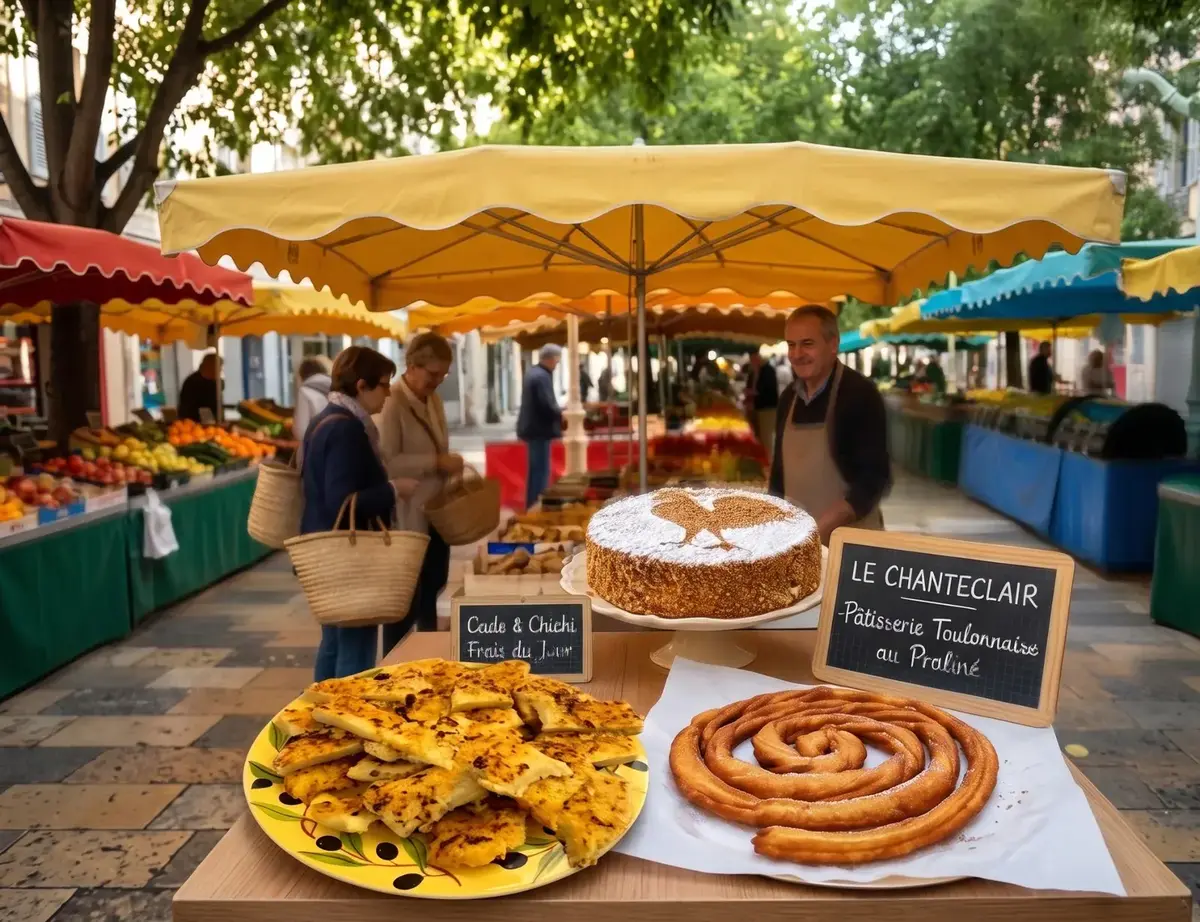
A piece served hot, a little salt, pepper if you like it, fingers rather than a fork, and the matter is settled.
In Toulon, cade belongs to a kind of cooking that did not develop in dining rooms. Its history lies in streets, markets and the naval shipyards. It was simple and inexpensive, substantial enough to feed workers and good enough to survive long after people stopped needing it simply to get through a working day.
Almost two centuries later, it is still here.
At a time when Toulon’s historic chichi frégi has almost vanished, that survival is worth examining.
A story beginning on the other side of the Alps
Looking for the official inventor of cade would probably be pointless.
Like many popular Mediterranean recipes, it belongs to a much larger family shaped by people moving around the coastline.
Its closest ancestor is found in Liguria: farinata, the large flatbread made from chickpea flour, water, olive oil and salt.
Région Sud connects the arrival of this family of recipes in southern France with Genoese workers travelling alongside Napoleon’s forces. In Toulon, local tradition refers more specifically to Genoese carpenters brought in to work in the naval shipyards. Cade then became established around Besagne, the working-class neighbourhood beside the arsenal.
This was the early nineteenth century.
Toulon was a military and industrial city. The arsenal employed a substantial workforce and the naval yards needed skilled workers.
Those workers also brought habits with them.
Among them was a chickpea batter cooked on large trays.
Cade therefore did not conquer Toulon because a restaurateur decided to market a new local speciality.
It began by feeding the people doing the work.
The workers’ snack
Var Tourisme records that cade was once hawked through the streets and served as a morning snack, or even lunch, for men working in the shipyards.
The reasons are easy to understand.
Chickpea flour produces substantial food from very few ingredients. No plates or cutlery are required. The large flatbread is cut into pieces and eaten while standing or walking.
Street food existed long before anyone thought of putting the English expression on a restaurant sign.
In Toulon, it tasted of cade.
Local tradition recorded by Var Tourisme also connects the name with the women selling it through Besagne. They are said to have shouted “Caldo!” — Italian for “hot” — while carrying their trays, with the call eventually becoming “cade” in local usage.
Whether linguistic history followed quite such a perfectly straight line matters less than what the story tells us.
Cade was hot.
It was sold in the street.
And people shouted to sell it.
Before becoming culinary heritage, it was an everyday trade.
Besagne, the arsenal and working-class Toulon
The history is difficult to separate from old Besagne.
Cade did not emerge from monumental Toulon. It belonged to the popular, maritime and working city.
That may explain why it retained such a distinctive place in local identity.
There is no rare ingredient to celebrate.
No inaccessible technique.
No complicated sauce.
Chickpea flour.
Water.
Olive oil.
Salt.
And fire.
Région Sud gives exactly the same list for Nice socca and Toulon cade.
Which is where trouble begins.
Because almost as soon as somebody explains cade, someone from Nice will eventually ask:
“So it’s socca?”
Not quite.
Cade and socca: cousins, not twins
Toulon and Nice can put away their weapons.
Cade and socca clearly belong to the same culinary family.
Both use chickpea flour, water, olive oil and salt. Both are traditionally cooked at very high temperatures, preferably over wood, and both should be eaten while still very hot.
But they aim for different results.
The most obvious difference is thickness.
Région Sud gives a useful comparison: approximately one to two centimetres for Toulon cade, against around half a centimetre for socca. Nice Côte d’Azur’s official recipe goes even thinner, recommending a layer of only two to three millimetres.
A few millimetres make an enormous difference.
Socca aims for crispness.
It is thin, blasted in an extremely hot oven, golden and deliberately allowed to darken or burn slightly in places. In Nice it is traditionally peppered and eaten immediately after leaving the oven.
Cade has considerably more body.
Its greater thickness gives it a golden, crisp surface while leaving the centre softer, more tender and almost creamy. Région Sud neatly summarises the contrast: socca gives more crunch; cade gives more softness.
Comparing them only through their ingredients would therefore be rather like declaring baguette and focaccia identical because both contain flour, water, yeast and salt.
Cooking is more than a shopping list.
Thickness, heat and technique matter.
So who copied whom?
This is normally the point at which the discussion becomes dangerous.
The sensible answer is: probably nobody, at least not in the modern sense.
Toulon cade and Nice socca are both regional versions of a much wider Mediterranean tradition based on chickpea flour.
Liguria has farinata.
Nice has socca.
Toulon has cade.
Related preparations exist in Sardinia, Tuscany, Gibraltar and on the other side of the Mediterranean. Région Sud likewise presents cade and socca as local developments from a common culinary history, with the thicker Toulon version remaining closer to Ligurian farinata.
They are therefore better understood as cousins than copies.
Each city adopted the preparation, adapted it to its own habits and eventually began regarding its version as entirely natural.
Problems only begin when somebody serves socca to a Toulon resident and says it is “exactly the same”.
Diplomatic relations between the Var and Alpes-Maritimes have faced crises over less.
From workers’ food to a Toulon symbol
Cade eventually moved far beyond its original role as a working man’s meal.
Var Tourisme now presents it as one of Toulon’s characteristic specialities.
Its function changed along the way.
People no longer buy it because they need enough food to last through a morning in the naval yards.
They buy it while visiting the market.
For an apéritif.
Because the children want some.
Because the smell from the oven has unexpectedly changed the lunch plan.
Or simply because they happened to walk past.
That is often how popular foods survive.
They lose the necessity that created them but keep the pleasure.
Cade is no longer a shipyard worker’s lunch.
It has become a piece of Toulon that can be eaten.
The essential role of the wood fire
One character in the story receives less attention than it deserves: the oven.
Traditional cade is baked over wood. That is more than folklore intended to entertain visitors.
High heat rapidly cooks and colours the surface while allowing the thicker interior to remain soft.
The large tray enters the oven.
The surface turns golden.
Some patches darken more than others.
The edges crisp.
Then the cade is cut.
Irregularity is part of the experience.
One piece has more crisp edge.
Another comes from the centre and is softer.
Anyone demanding precisely the same texture in every bite may have chosen the wrong speciality.
Cade is not an industrial biscuit.
It still carries the marks of the way it was cooked.
La Cade à Dédé: part of the landscape since 1989
The tradition has not survived only in memories.
La Cade à Dédé has been part of Toulon’s culinary landscape since 1989. Var’s official tourism service still lists its two mobile stalls at the Cours Lafayette and Mourillon markets, serving cade hot.
It has also developed versions with anchovies, olives and spring onions, together with a sweet fig version.
Purists may spend hours debating whether a recipe that works perfectly with four ingredients needs changing.
They are entitled to do so.
Popular food has always evolved.
The more important question is whether the basic preparation survives.
It does.
La Fabrique de Cade, still on Cours Lafayette in 2026
Another business demonstrates the difference between cade’s fate and that of Toulon’s historic chichi frégi.
La Fabrique de Cade operates at 98 Cours Lafayette. Provence Méditerranée’s tourism office says the family has been maintaining its cade-making tradition since 1988 and continues to produce and sell it in central Toulon in 2026.
As of 17 August 2026, it is listed as open every day from 9am to 1pm during the summer season until 28 September. From 1 October, the announced schedule changes to Tuesday through Sunday mornings.
That address matters more than it may appear.
The story of chichi frégi raised one question: how can a city lose a food that seemed to belong to its identity?
With cade, the opposite question can still be asked:
how do we stop that happening?
Chichi and cade: two different destinies
The histories almost run in parallel.
Both chichi frégi and cade belonged to Toulon’s streets.
Both were associated with Cours Lafayette and local markets.
Both were eaten with the fingers.
Both crossed generations.
Their recent paths, however, have diverged.
The historic Guglielmi chichi left Toulon together with the family that held its recipe.
Cade still has several makers, several lines of transmission and several places where it can be bought.
It is therefore not locked inside a single family secret.
That difference matters.
Living heritage becomes particularly fragile when only one person still knows how to make it.
Cade still has a small community of guardians.
No need to put it in a museum
One day, somebody could easily build a museum display about cade.
An old tray.
A photograph of a street seller.
A few lines explaining Besagne, the Genoese and Toulon’s shipyard workers.
It would be interesting.
It would also be a bad sign if that became the only place to find it.
The best way to preserve culinary heritage is not necessarily to put it behind glass.
It is to eat it.
Buy a portion at the market.
Explain to a child that no, it is not a pancake.
Tell a visitor that no, it is not exactly socca either.
Burn your fingers slightly because you were too impatient to wait.
Add too much pepper.
Take another piece.
Transmission can be as simple as that.
Cade versus socca: the verdict
There had to be one eventually.
So here is the result of the great Mediterranean confrontation.
Common culinary ancestry: a draw.
Same main ingredient: a draw.
Socca: thinner, drier and crispier, cooked under fierce heat and often darkened almost to the point of burning in places.
Cade: noticeably thicker, crisp on the surface but much softer and more tender in the middle.
Nice has socca.
Toulon has cade.
Liguria has farinata and is probably watching the French argue over ownership of chickpeas with some amusement.
Everyone can therefore go home satisfied.
On one condition.
Never ask somebody from Toulon where to find good socca on Cours Lafayette.
Even today, what you eat there is cade.
And unlike some of the city’s other old symbols, this one is still very much alive.