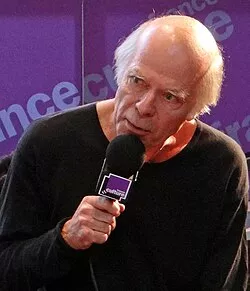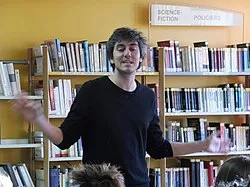

On paper, there is something unexpected about this pairing. Boris Cyrulnik has devoted much of his work to attachment, trauma, resilience and the way human beings develop through their relationships with others. Bernard Werber has spent decades using fiction as a laboratory in which science, philosophy, animals, imagined societies and questions about humanity’s place in the living world constantly intersect. On Saturday, 22 August, those two paths will cross in Toulon.
The event is scheduled from 6:30 p.m. to 9 p.m. at the Théâtre Sainte-Jeanne d’Arc, 67 rue Docteur Fouques, as part of the Les Entretiens de l’été festival organised by Jérôme Lévy. Its central theme — “From the human brain to the wisdom of trees: how can we rebuild our societies?” — makes its ambitions clear. This is intended to be more than the presentation of two books: it will bring two perspectives into conversation around individuals, societies and the world they inhabit. A book-signing session is due to follow the discussion.
Two books, two routes towards the same question
Boris Cyrulnik comes to Toulon with Au saccage des petits bonheurs, published by Éditions Odile Jacob on 15 April 2026. The book continues a line of thought running through much of his work: human beings do not develop in isolation. Behind questions of civilisation, relationships and what allows an individual to become fully human lies another issue — the social fabric we collectively create, and which we are equally capable of damaging.
Even the title turns away from the dramatic vocabulary often used when discussing contemporary crises. It focuses instead on “small pleasures”: everyday relationships, routines, human connections and ordinary forms of security and consideration. That shift in scale may prove one of the most interesting aspects of the Toulon discussion. Thinking about the future of a society can also begin by examining what that society does to the people living within it.
Bernard Werber approaches the subject from an entirely different direction. La Voix de l’arbre, published by Albin Michel on 1 October 2025, blends adventure, science and fiction around a question entirely consistent with Werber’s literary universe: what might happen if human beings could genuinely listen to what trees had to say? The forest and humanity’s relationship with the living world provide the starting point, with imagination serving as a way to shift the reader’s perspective.
For Werber, looking at humanity through other species is hardly new. Animals, biological systems and alternative societies have repeatedly provided him with ways of observing human behaviour from an unfamiliar angle. Seen in that light, his encounter with Cyrulnik becomes far less unlikely: one studies what enables human beings to live and develop together, while the other uses fiction to question whether our view of the world has become excessively centred on ourselves.
More than a conventional literary appearance
That is what gives the Toulon event an interest beyond the usual presentation and signing session. Les Entretiens de l’été has brought the two guests together around a shared question rather than simply placing two separate talks on the same programme. The organisers also frame the discussion as a journey “from inner experience to collective destiny”, neatly capturing the expected movement from the individual towards society.
The contrast between their methods is precisely what makes the combination useful. Cyrulnik approaches these issues through his experience as a neuropsychiatrist and through the human sciences. Werber works in the territory of novels, hypotheses and storytelling. One seeks to understand the processes through which human beings develop; the other invents situations capable of unsettling the reader’s assumptions. There is little reason to expect them to offer identical answers. That is precisely the point.
At a time when ecology, social cohesion, collective trauma and humanity’s relationship with the natural world occupy an increasingly visible place in public discussion, bringing these perspectives together in Toulon gives the event a significance beyond the publishing schedules of its two guests. A few hours of conversation will not settle questions of this scale. What it can do is restore one of the roles books have always been capable of playing: not merely objects to be read, but starting points for discussion.
Literature as a place for conversation
That matters to local cultural life. Literary news cannot be reduced to publication dates or stacks of new releases at the entrance to a bookshop. It also exists whenever books leave the shelves, metaphorically or literally, and become part of a public conversation.
Bringing Boris Cyrulnik and Bernard Werber together offers exactly that possibility. Readers already familiar with both writers will be able to see two very different bodies of work placed side by side. Those who mainly know one of them may discover the other through the unexpected connections created by the discussion.
The 22 August event is therefore likely to range across the brain, trees, civilisation, human relationships and the future. That is a considerable amount of territory for one evening. Yet behind those apparently disparate subjects lies a much simpler question, and one that concerns everyone: how do we continue living together while remembering that we do not live alone?
The conference begins at 6:30 p.m. on Saturday, 22 August 2026, at the Théâtre Sainte-Jeanne d’Arc, 67 rue Docteur Fouques in Toulon. The ticketing information lists a 9 p.m. finish, with a signing session following the discussion. Reservations are handled through Les Entretiens de l’été.