
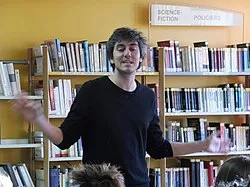
The connection with the Var may begin with a single biographical fact, but it gives this year’s literary season a local resonance. Sylvain Prudhomme was born in La Seyne-sur-Mer in 1979. His life and writing soon travelled far beyond the Toulon roadstead, developing through Africa, journeys, roads and the people encountered along them. On 27 August 2026, he will publish De l’autre côté du lac with Éditions de Minuit.
The novel arrives after a decade in which Prudhomme has become an established figure in contemporary French literature. Par les routes won the Prix Femina in 2019. Les Orages followed in 2021, then L’Enfant dans le taxi in 2023 and Coyote in 2024. De l’autre côté du lac is his third book with Éditions de Minuit.
A lake and a disappearance
The novel begins with a handful of straightforward but unsettling elements.
Near a high-altitude lake, a group of researchers is working on the edge of a nature reserve from which humans are forbidden. A photographer notices something on one of the slopes that nobody else appears to see. Strange signs begin to accumulate. A body is found. Yet the photographer decides to remain there alone.
A few months later, she too disappears.
That premise might suggest a conventional crime novel or thriller. The publisher’s presentation points elsewhere. The mystery appears to provide Prudhomme with another way of approaching concerns already present in his writing: the desire for a more intense existence, the attraction of wild spaces and the dream of escaping lives that have become too carefully organised. Éditions de Minuit describes the novel in terms of a desire for intensity, the call of the wild and the dream of a more authentic life.
That seems a more useful way into the book than a simple genre label. In Prudhomme’s work, roads, borders and journeys rarely function as scenery alone. They are places where characters temporarily lose the protection of routine.
From roads to mountains
The move towards a high-mountain landscape may therefore be less of a break than it initially appears.
Movement and hitchhiking were central to Par les routes. In Coyote, Prudhomme returned to material gathered during a 2,500-kilometre hitchhiking journey along the border between the United States and Mexico, recording encounters with people living on both sides of that political and geographical divide.
De l’autre côté du lac appears to preserve that fascination with boundaries. This time the frontier is neither a road nor a wall, but the edge of a reserve into which human beings are not allowed.
That detail immediately creates a literary question: what happens when a character looks towards — and perhaps crosses — the point where she has been told to stop?
The central character’s profession adds another dimension. She is a photographer, someone whose work depends upon looking. She sees something the others do not. Without pretending to know more than the publisher has revealed before publication, that premise already creates a tension between observation and interpretation. Seeing does not necessarily mean understanding, and being the only witness does not necessarily mean being right.
From La Seyne-sur-Mer to the Prix Femina
For readers in the Var, the publication is also an opportunity to return to an author whose birthplace is less widely known than some of his books.
Sylvain Prudhomme was born in La Seyne-sur-Mer in 1979. He spent part of his childhood in several African countries before studying literature and developing a career as both novelist and reporter. Contemporary Africa played an important role in his earlier writing, shaped partly by periods spent in Senegal, Niger, Burundi and Mauritius.
His bibliography then expanded steadily across different territories and forms. Là, avait dit Bahi appeared in 2012, Les Grands in 2014 and Légende in 2016. Par les routes, published in 2019, brought him the Prix Femina and considerably wider recognition.
Success did not lock his writing into a single formula. L’Enfant dans le taxi turned towards family history and the traces left by the post-war period. Coyote moved closer to literary reportage. The novel arriving in August 2026 appears more concerned with unease, isolation and the unknown.
That movement may be what makes his career worth following: each book changes the terrain without entirely abandoning the questions explored in the one before.
The French literary season from the Var
The French rentrée littéraire has a habit of compressing an extraordinary number of new books into a few weeks. In that rush, connections with particular towns and regions can easily disappear behind publishers’ catalogues and the first literary-prize lists.
De l’autre côté du lac is a reminder that national literary life also has local roots.
There would be little sense in presenting Sylvain Prudhomme as a regional writer. His work plainly refuses such a narrow definition. Nor does being born in La Seyne-sur-Mer make his novels somehow “Var literature” when they make no such claim themselves.
The interesting point lies elsewhere. A writer born beside the Mediterranean, whose life and fiction have moved through numerous countries and landscapes, is now publishing with one of the most recognisable houses in contemporary French literature.
A region’s literary life is not made only of books that describe that region.
It is also made by writers who leave, travel, change landscapes and write elsewhere.
Due on 27 August
De l’autre côté du lac will be published by Éditions de Minuit on Thursday 27 August 2026. The print edition runs to 288 pages, with a digital edition also announced.
At this stage, before critics and readers have had the opportunity to form their own views, there is little value in pretending to know whether the novel succeeds. A publisher’s synopsis can establish an atmosphere; it cannot provide a verdict.
What it does reveal is Prudhomme’s choice of a landscape where human beings are no longer entirely at home. A forbidden reserve, a lake, a photographer who sees something nobody else sees, followed by two disappearances: the premise is already enough to create unease.
Ten days before publication, that is reason enough to keep the book in view.