
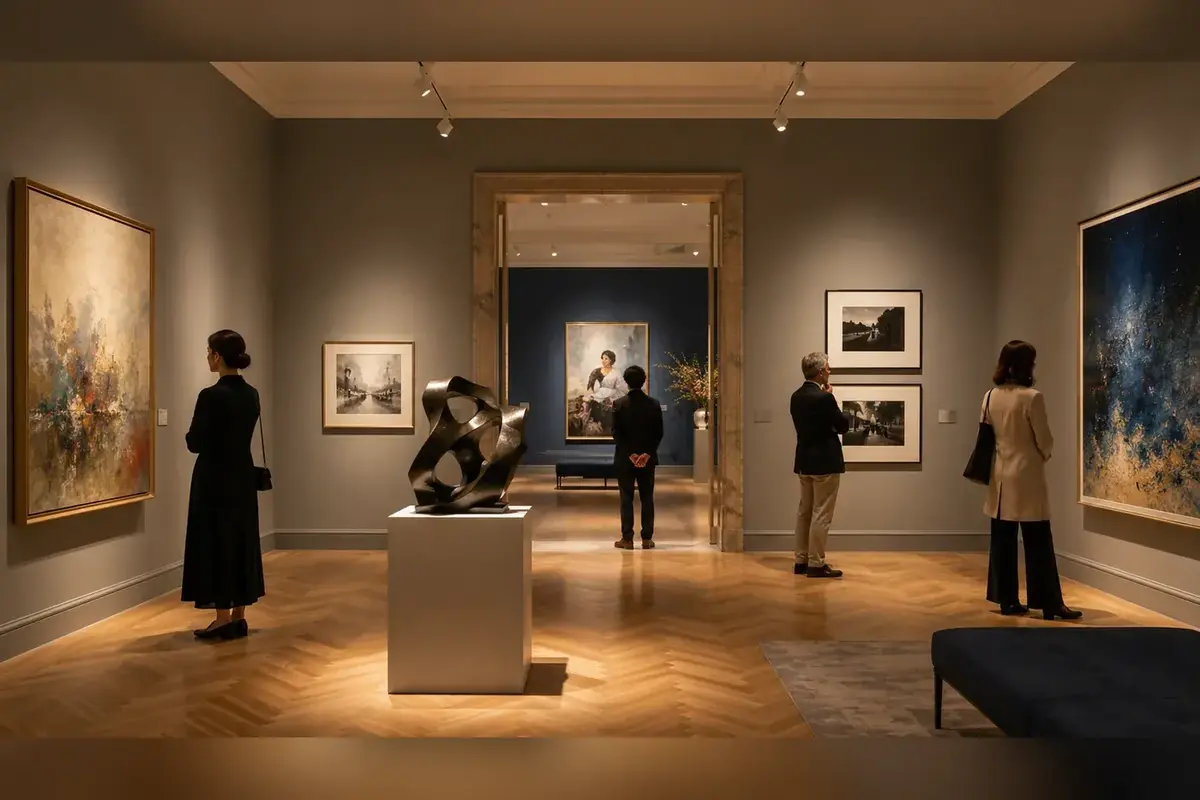
Should photography show the world as it is, or can it transform reality until it becomes almost unrecognisable? In Toulon, a walk between the Musée d’Art and the Maison de la Photographie currently offers two very different answers.
On one side stands Man Ray. On the other, Martin Parr. Two photographers from different generations, using the camera in almost opposing ways.
Running at the Musée d’Art de Toulon until 31 October 2026, “Man Ray, la magie de l’image” returns to the world of an artist for whom photography was never simply a means of recording what stood before the lens. A major figure of the avant-garde and Surrealism, Man Ray made experimentation central to his practice. Toulon presents his work through photography, visual experimentation and poetic approaches to the image.
At the Maison de la Photographie, “Short and Sweet” tells a very different story. On view until 19 September, nine series trace almost fifty years of Martin Parr’s observation of society. Produced in collaboration with Magnum Photos, the exhibition moves from his early black-and-white work to the highly saturated colour photography that became one of his trademarks.
Making an image, observing a world
For Man Ray, reality is raw material. It can be displaced, distorted, lit differently, combined with objects or subjected to the unexpected effects of photographic experimentation. What matters is not necessarily what was originally in front of the camera, but what can eventually appear in the image.
This was one of the crucial changes introduced by the early twentieth-century avant-garde: photography gradually stopped having to justify itself through fidelity to reality. It could become autonomous, strange, abstract and occasionally unsettling.
Throughout his career, Man Ray repeatedly blurred artistic boundaries. Photographer, painter, filmmaker and maker of objects, he belonged to a generation unwilling to allow artistic disciplines to settle comfortably into separate categories.
Photography became a laboratory.
Martin Parr appears to begin at the opposite end of the spectrum. He does not remove the world from view. Instead, he looks at it with a degree of precision that can sometimes become uncomfortable.
His subjects are often remarkably ordinary: holidaymakers, food, beaches, shops, crowds and familiar gestures. Yet framing, proximity, repetition and, above all, colour allow something else to emerge from that apparent banality.
The Maison de la Photographie describes his work through its combination of humour, satire and observation of collective behaviour. Leisure and consumer culture run throughout photographs in which absurdity rarely has to be created by the photographer. It is already there in the scene.
Two exhibitions in conversation
The connection is not the result of a joint retrospective. These are separate exhibitions. Their simultaneous presence in Toulon nevertheless creates an intriguing dialogue.
Man Ray manipulates images to escape straightforward reality. Martin Parr observes reality so insistently that it can eventually begin to look unreal.
Almost a century of photographic history lies between those two positions.
Their proximity also serves as a reminder that photography has never developed simply because cameras became technically better. Each generation has had to decide what to do with a machine capable of preserving a fraction of a second.
Documentation, testimony, beauty, criticism, experimentation, provocation, memory and fiction have all become part of photography, frequently at the same time.
Toulon’s current programme makes that diversity unusually easy to see. Only a short walk separates the two venues, and the contrast does much of the explaining.
Photography already has roots in Toulon
This summer programme is not appearing in isolation. The Maison de la Photographie opened in the old town in 2002 as an extension of the Musée d’Art de Toulon’s photographic collection. The collection now contains more than 400 works and includes photographers such as Henri Cartier-Bresson, Robert Doisneau, Denis Brihat and Lucien Clergue.
Photography therefore already has an institutional history in the city. What makes the summer of 2026 interesting is the way that history is being made visible to a wider public.
Man Ray leads visitors back towards the experiments that transformed the very idea of what a photograph could be during the twentieth century. Parr brings them much closer to contemporary behaviour: holidays, consumption and our peculiar ability to turn ourselves into a spectacle.
In a Mediterranean city whose beaches, terraces and streets fill during summer, Parr’s photographs of leisure acquire an additional resonance. His pictures are not about Toulon, but it is difficult to look at them without thinking about what is taking place outside, only a short distance away.
Seeing the familiar again
This may be the most convincing point of contact between the two photographers.
Neither Man Ray nor Martin Parr is satisfied simply to show.
Man Ray takes an object, face or silhouette and asks how an image might strip it of its obvious meaning. Parr photographs scenes we have encountered countless times and makes them strange enough for us to look again.
In both cases, photography truly begins when the subject stops being self-evident.
“Man Ray, la magie de l’image” is on view at the Musée d’Art de Toulon, 113 boulevard Général-Leclerc, until 31 October. The museum is open Tuesday to Sunday from noon to 6pm.
Martin Parr’s “Short and Sweet” runs at the Maison de la Photographie, rue Nicolas-Laugier, place du Globe, until 19 September. Admission is free, with opening hours from noon to 6pm, Tuesday to Saturday.
Ultimately, the two exhibitions are not merely about two photographers. They present two ways of using an image. One transforms reality; the other stares at it until its oddities become visible. This summer, Toulon offers the rare opportunity to move from one approach to the other within a few minutes’ walk.